
Sitting in the Sorting
Thoughts on puzzling, patience, and success

When I taught college English, I’d encourage my students to read in drafts. Like writing, reading can be done in stages, with each read-thru serving a different purpose. Even the best readers can’t get everything they need from a text in one swoop. Good readers preview and predict. We skim to get an idea of the content and difficulty. We read for the main idea then go back for details. If studying for a quiz, we review key dates and facts. If writing an argument, we return searching for evidence to support our claim.
It’s a challenge to get students to read the text even once, much less multiple times. Yet my most successful students are the ones who are comfortable returning to the text again and again.
They don’t believe the lie that they should know the answer already. They don’t trust half skims or Chat GPT summaries. They read for themselves, and read again. Until the answer emerges.
A key trait of successful students, therefore, is not intellect but patience and distress tolerance. Do they keep going when the homework is taking longer than they hoped? Can they admit to themselves that they don’t know the answer off the top of their head? Can they let the process take the time it takes?
Perhaps I’m not just writing about my students.
///
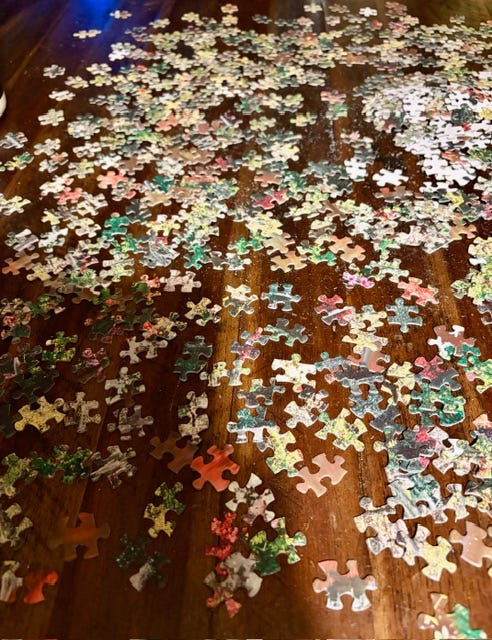
I sit on the couch and lean over the coffee table; a 1000-piece puzzle box balances precariously on my lap. I don’t have much space, but I do have a system. Like most people, I start with the edges. My space is limited, so I sort in drafts. I methodically pick up each of the 1,000 pieces in one half of the puzzle box and move all the edge pieces to the coffee table while non-edge pieces get transferred to the empty box top. Piece by tedious piece, I pluck and place. At first, I’m looking for smooth edges as the only distinguishing feature. The colors and patterns themselves are visual gibberish. Blobs and lines and a whole lot of textures. After one round of transfer, I begin to piece together the frame.
I return back to sorting for another round. This time, with a little more familiarity with the puzzle, I search for a new salient feature. Sometimes it’s a background color or pattern. The water or trees or lava. A type of roof or a color of a building. I now can see there are three shades of pale blue–the clouds above the mountains, the snow, and the clouds reflected in the water, each slightly different in a way my eyes can see but words can’t describe. I follow the same method, picking through the now full box one piece at a time, transferring what I can recognize–three shades of blue–to the coffee table and moving the rest to the empty box. Then I piece together the sections with the focus feature. Sky, snow, clouds below.
It’s not ideal. A puzzle board would help a lot. On a smaller puzzle, I could dump all of the pieces at once. Turn them over and organize that way. My lack of space has forced me to puzzle in drafts. I’m tempted to find and place every piece, but there’s no room. I must go section by section. Sometimes this means recognizing a piece but moving it to the slush box anyway, trusting its time will come.
Perhaps I’m not just writing about puzzles.
///
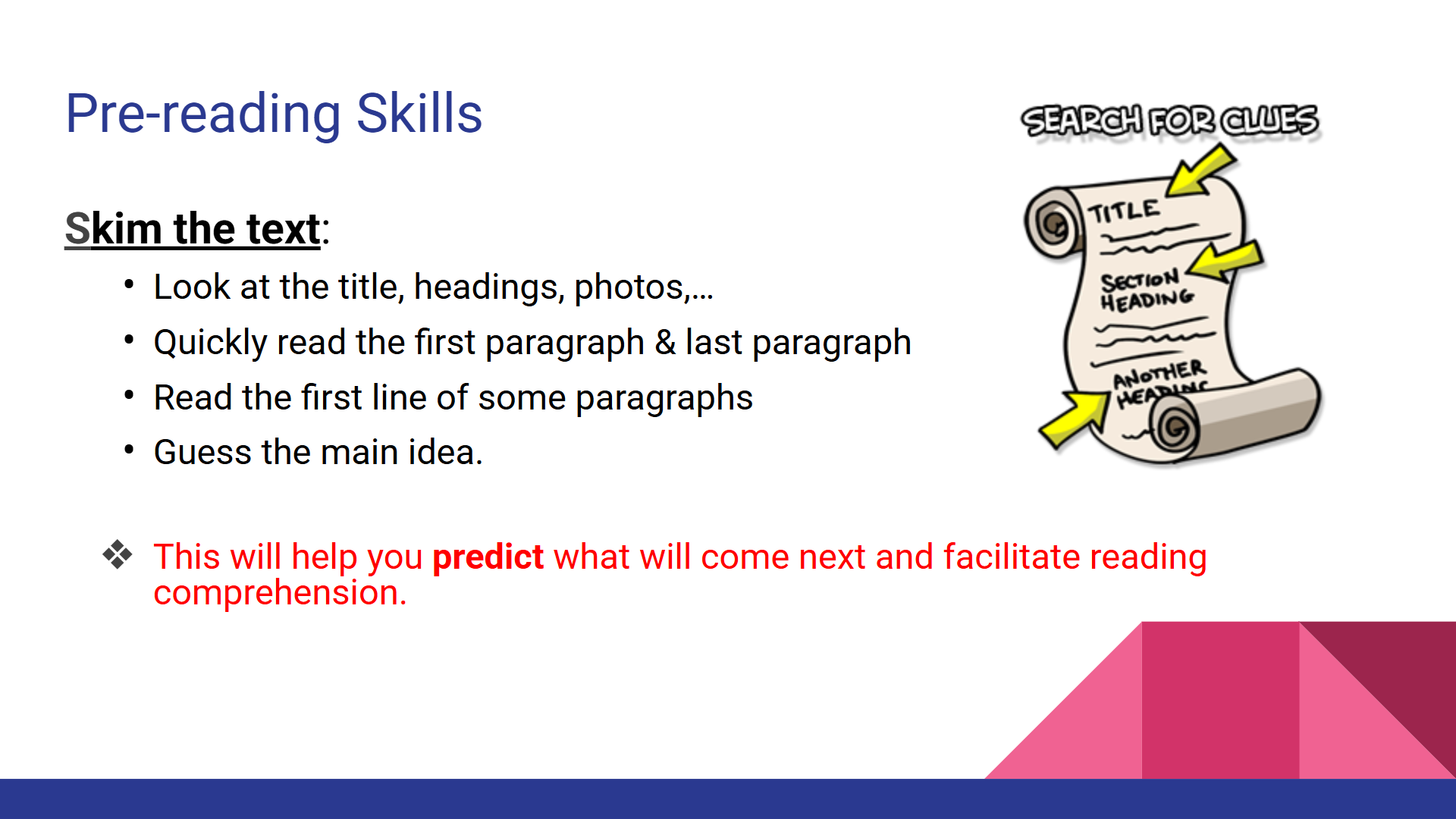
I found my students didn’t automatically know how to read in drafts, so I modeled this skill for them. Each read-through counted as its own grade in my grade book.
We could spend a 1 hour and 15-minute class session previewing, making predictions, and skimming and discussing a two-page reading.
“Based on the title, what do you think the text will be about?”
“What kind of text do you think it is? Opinion, argument, personal essay? What clues lead you to believe this?”
“What do you already know about the topic? What do you expect to learn?”
Then I’d send them home with additional close reading questions. I’d label the worksheets: pre-reading, close reading, language focus, etc.
The next session we’d dive deeper into the same two-page article. I’d model note taking and marking up the text with a process called think aloud. I’d share my real-time thoughts and associations.
“I can tell by the bolding here that this must be an important term.”
“The use of “I” tells me this is in the first person. Since this is in quotations, I know the author is bringing in evidence from someone else.”
“Since we know we’re going to be writing our own opinion piece, I’m going to underline all of the persuasive language I see, like this use of the collective “we” to form common ground with the reader.”
In the beginning of each semester, my students would groan and complain about these lengthy discussions. They would try to get me to pass out the homework early, read ahead, or tune out on their smart phones. As the semester went on, students began to anticipate my pre-reading questions. Eager hands would shoot up to identify the text’s genre or connect the title to something they were learning in another class. The answers on the homework went from one-word phrases to full paragraphs and quotations that they later utilized in their essays. Their eyes would light up with understanding the second or third time we discussed a text. Multiple exposures aided comprehension.
Sure, I liked to teach my students skills and techniques, but I wonder if the most valuable lesson I could show them was just how much time it takes to truly understand a text. In a culture that values efficiency and digital shortcuts, it is invaluable to learn they’re not doing it wrong if it takes time.
Sometimes we’re lucky enough to have people in our lives who model patience through life’s uncertainties. Many of us are figuring it out as we go, pushing back against the inner critic that says we should know all of this already.
///
There is something comforting about my puzzling process; rhythmic, calming. When all the pieces start to look alike or revert to gibberish again, I step away. It’s remarkable what a good night’s sleep will do for my puzzling abilities. A nonsensical piece finds a clear home in the light of the morning.
I don’t know how many transfers I make throughout the course of the puzzle. By the end, though, when I’m down to 50-100 pieces, I can pick up and pinpoint exactly where any piece should go. I’ve seen that individual piece 10, 20? times and all of those past times it didn’t mean anything--just colors and shapes. Until it does. One glance and I know it’s a piece of a giant’s leg or a squid’s tail or shadow of snow.
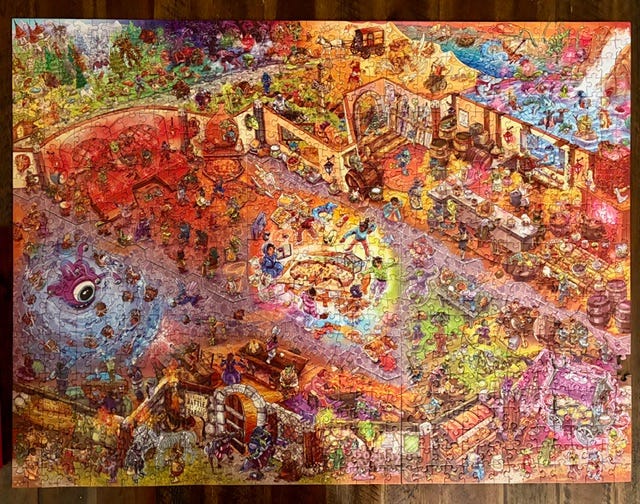
Damn, that’s satisfying.
Of course, life is not quite as linear as solving a puzzle or drafting a response paper. I love the promise of a puzzle: surrender to the sorting and sense will be made.
Perhaps life could be as satisfying as a good puzzle–or at least less frustrating– if we let ourselves sit in the sorting for longer. Without rushing to an answer or tweetable lesson or finished product. If we become more comfortable with drafting.
Could we let ourselves take the time we need? Step by tedious step. Draft by circuitous draft. Layer by layer. Loop by loop. Until the picture becomes a little clearer.
Wouldn’t that be satisfying? Maybe even the definition of success.
***
I’m curious, do you have anyone in your life who models patience in this tedious sorting period? How do you handle revisiting a challenge or lesson or theme over and over? I think this idea could apply to writing, creativity, parenting, friendships, you name it! In what area of your own life would you like to become more comfortable sitting in the sorting? And what are your favorite puzzles!
Goodness, I needed the words of this essay today! I wish I could be more content and patient as I sort through the process of mending my relationship with my body. I just want to love it and be done 😂 but its just not that simple.
Thanks for sharing your thoughts and this essay, friend!
I love how this essay turned out, Aly! As always, you offer a much needed reminder to embrace the process rather than striving for perfection. Definitely a reminder I need in all areas of life, but especially right now in writing!